Constraint on Dense Matter Equation of State
Neutron stars are the dense, highly magnetic remnants of massive stars, providing a natural laboratory to study matter under extreme conditions. Constraining the Equation of State (EoS) of ultra-dense matter is key to understanding their internal structure, mass-radius relation, and thermal evolution. One effective approach is to study neutron star cooling, comparing theoretical predictions with observed surface temperatures across stars of different ages.
In this work, we re-analyzed XMM-Newton and Chandra observations of dozens of isolated neutron stars and identified three unexpectedly cold young sources: two rotation-powered pulsars (RPPs, PSR J0205+6449 and PSR B2334+61) and one central compact object (CCO, SNR Vela Jr). These objects could not be explained by standard “minimal” cooling models, which only include slow neutrino emission processes. To investigate, we performed extensive magneto-thermal simulations covering different EoSs, neutron star masses, and a wide range of magnetic field strengths. The simulations show that only models accounting for enhanced cooling mechanisms—such as nucleonic or hyperonic direct Urca processes, can reproduce the observed low temperatures.
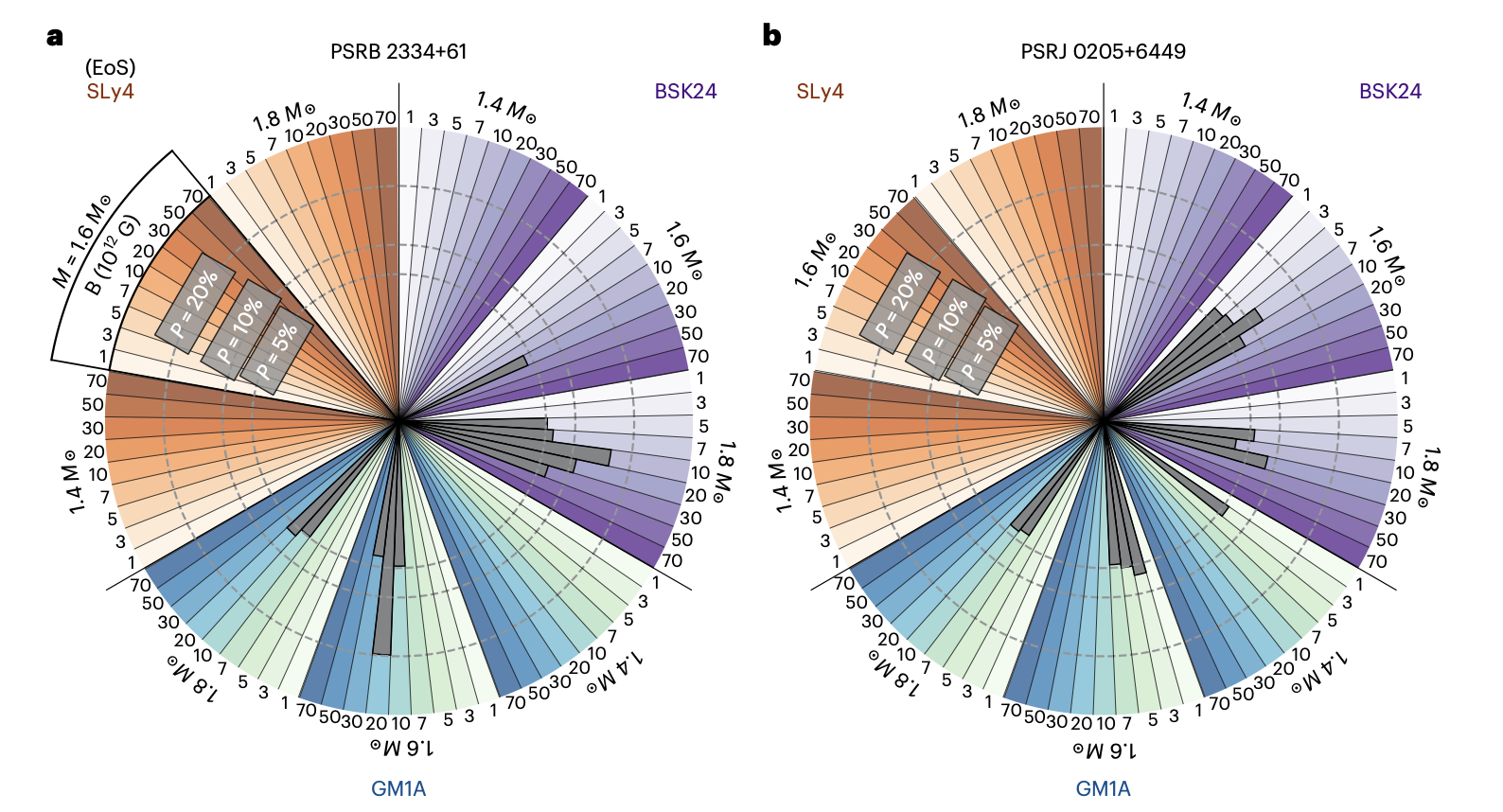
To rigorously determine which scenarios best matched the observations, we applied machine learning techniques to compare our simulations with the data in a multi-dimensional parameter space, including thermal luminosity, spin period, spin-down rate, and source age. This approach allowed us to quantify which combinations of mass, magnetic field, and EoS are compatible with the cold neutron stars, confirming that EoSs lacking fast cooling mechanisms are strongly disfavored. We found that only EoSs (and compositions) permitting a rapid cooling process within the first few thousand years can reproduce the thermal emission of all sources in our sample.
While a comprehensive exploration of all possible fast-cooling channels—such as hyperons, quarks, or nucleonic matter with very large symmetry energy—is beyond the scope of this work, the implications are striking. Using a simplified nucleonic meta-model, we estimate that roughly 75% of currently proposed EoSs lack a sufficiently high proton fraction to activate fast cooling in any reasonable neutron-star mass. Despite its simplifications, this analysis demonstrates that a substantial fraction of existing EoSs are potentially ruled out by the mere existence of these cold, young neutron stars, providing some of the most stringent observational constraints to date on dense matter physics and neutron star cooling.