
Finite-Temperature Nuclear EOS
This work (Dehman et al., A&A 687, A236 (2024)) extends the BCPM nuclear energy-density functional—originally developed to describe cold neutron stars—to finite temperatures in order to study hot compact objects such as late stage proto-neutron stars or following a post-merger event forming a hot neutron star. Using microscopic Brueckner–Hartree–Fock input and self-consistent Thomas–Fermi calculations, we construct a unified equation of state (EOS) that treats both the hot inner crust and the dense uniform core within the same theoretical framework. Their analysis shows that temperature has a profound impact on crustal structure: as the star heats up, the crust–core transition density decreases rapidly, and nuclear clusters disappear entirely above a limiting temperature of 7.21 MeV, beyond which only uniform matter remains.
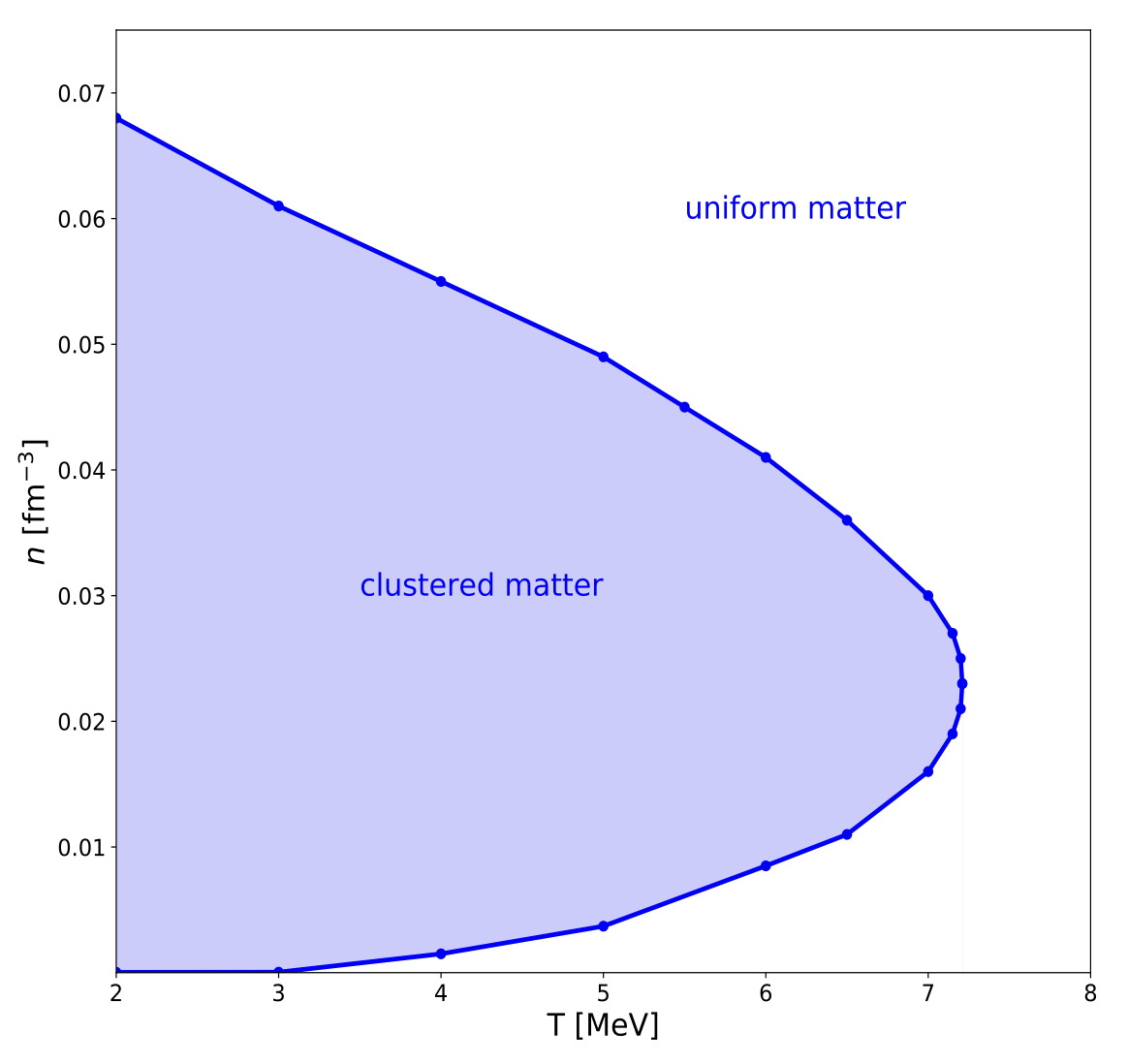
Below this limiting temperature, the inner crust exhibits two distinct transition densities—a higher one analogous to the cold crust–core boundary, and a newly emergent lower one where hot uniform matter becomes more stable than clustered matter in the outer layers. This behavior arises from thermal evaporation of neutrons and protons from nuclear clusters, modifying the balance between nuclear, Coulomb, and thermal effects. The study also provides complete finite-temperature EOS tables that smoothly join the hot inner regions to a cold outer crust at low densities.
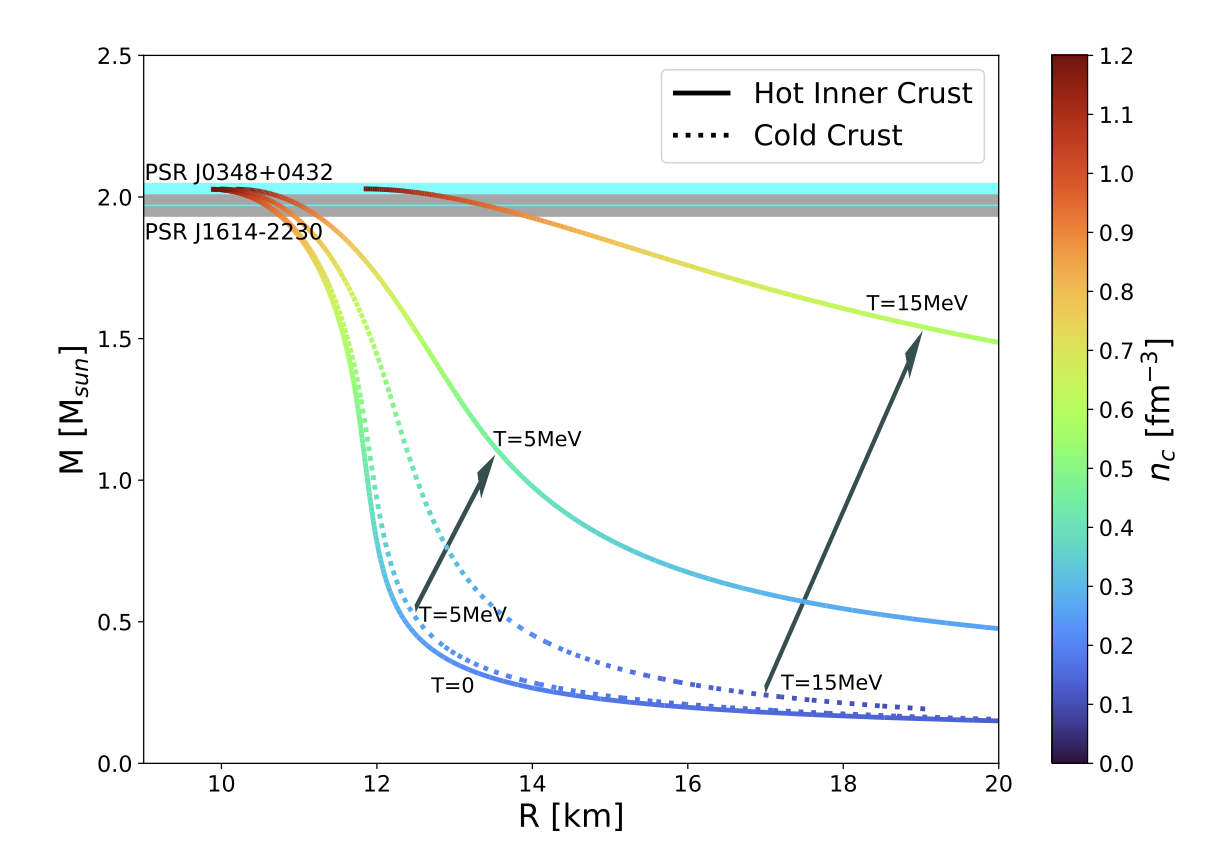
Using these EOSs, we compute mass–radius relations for isothermal neutron stars at different temperatures. We find that while the maximum mass changes only slightly with temperature, stellar radii increase significantly as the star becomes hotter, making hot neutron stars more extended and less compact. Crucially, the results show that including a hot inner crust is essential: using a cold crust together with a hot core severely underestimates the radius inflation caused by thermal effects. This work therefore provides a fully unified finite-temperature EOS and highlights the important role of the hot crust in modeling late-stage proto-neutron stars and the post-merger event forming a hot neutron star.