
Long-Period Transients
This work proposes a new evolutionary pathway for long period transients (LPTs), a recently discovered class of extremely slow pulsars that emit radio bursts with periods from tens of minutes to several hours. Although magnetars are natural candidates for isolated LPTs, their very low quiescent X-ray luminosities and sporadic radio activity contradict how traditional magnetar evolution is expected to unfold. Using detailed magneto-thermal simulations, we show that if strong magnetic currents are born inside the fluid core of a neutron star, the magnetic field decays very slowly for up to a million years. During this period, the star cools passively without converting magnetic energy into heat or radiation and remains invisible across all wavelengths — a dormant magnetar hidden in the Galaxy.
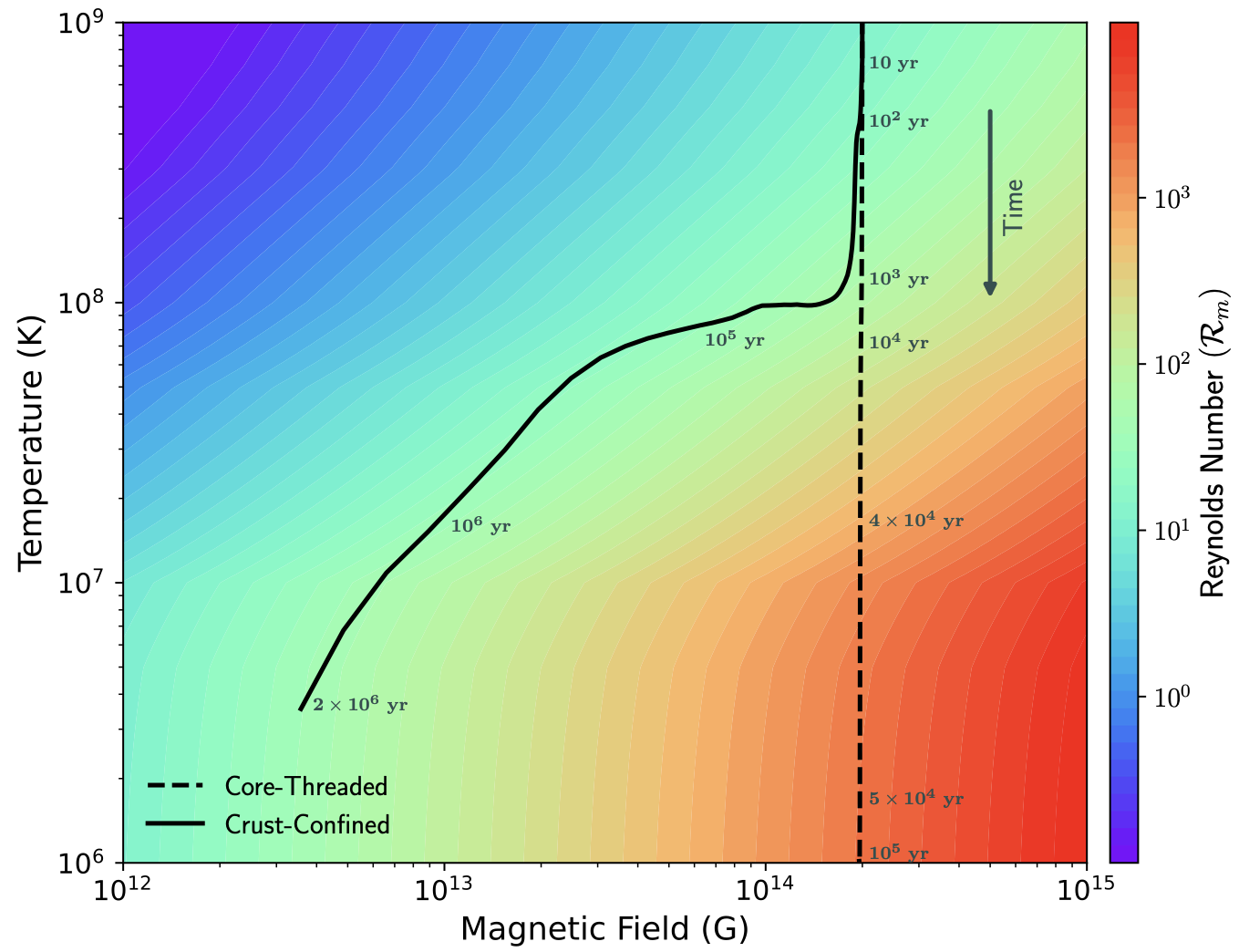
Once the crust cools sufficiently, the Hall effect abruptly accelerates magnetic evolution. The strong internal field begins to reorganize, building stresses that occasionally exceed the crust’s breaking threshold. These “crustal failures” inject magnetic twists into the magnetosphere, acting like a sudden recharging of the pulsar engine. Even for extremely slow rotators, such twists can locally accelerate particles and ignite radio emission, explaining why LPTs can switch between radio-loud and radio-quiet states. The statistics of these failure events in our model — infrequent, weak for most events, and concentrated near the magnetic poles — naturally reproduce the tiny duty cycles of LPTs and the polar hotspots observed in the recent multiwavelength detection of DART/ASKAP J1832-0911. Most bursts would be too weak to heat the surface measurably, explaining why nearly all known LPTs remain undetected in X-rays.
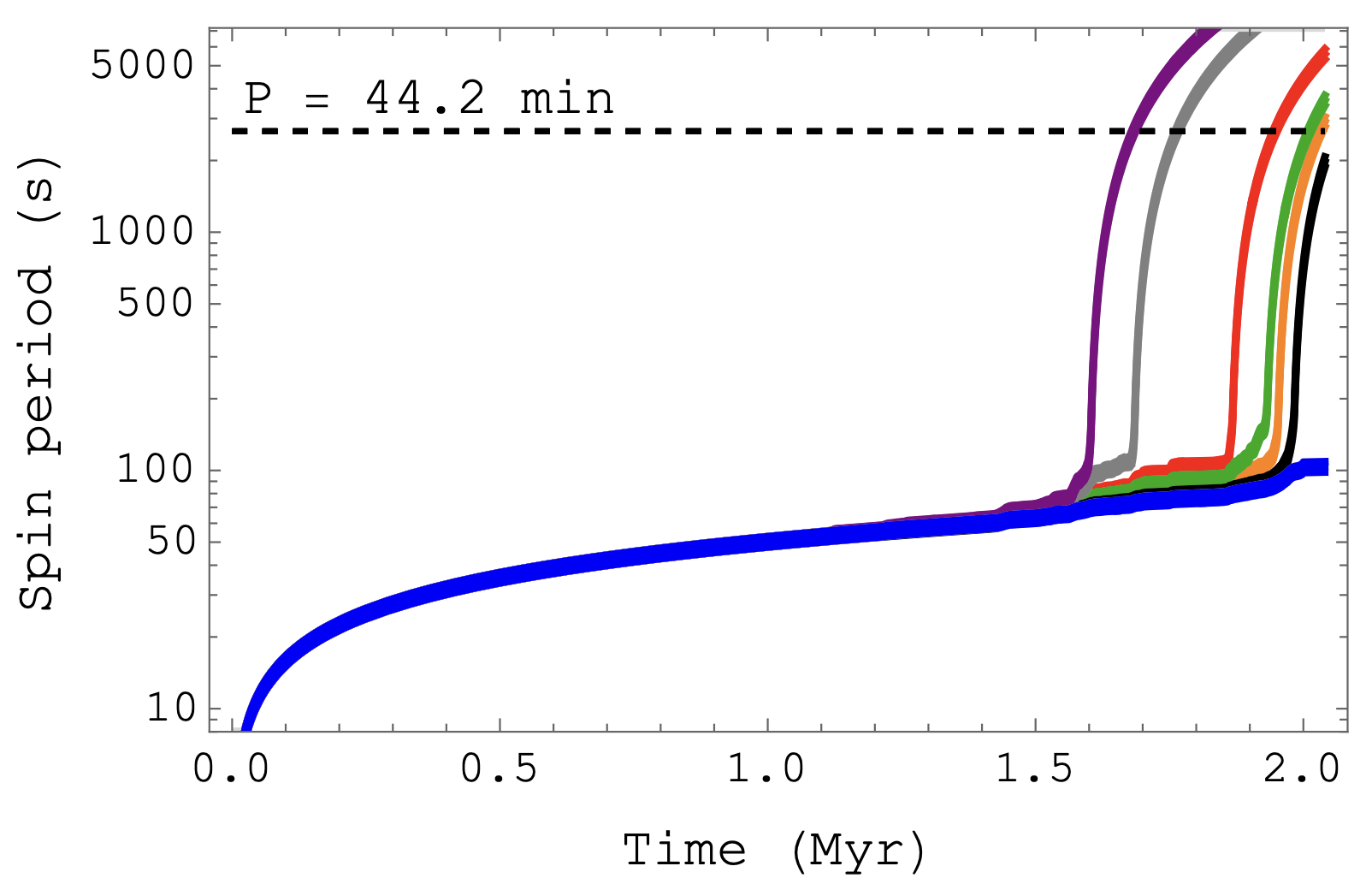
A key result of this work is that crustal failures do more than just activate radio emission: they dramatically accelerate spin-down, the gradual loss of rotational energy that makes neutron stars slow over time. Ordinarily, a pulsar spins down smoothly as electromagnetic waves carry angular momentum away from the rotating magnetic field. However, during a crustal failure, the star’s magnetic structure changes abruptly. Newly twisted magnetic field lines become open or distorted, enhancing torque from the magnetosphere and draining rotational energy much more rapidly than standard dipole braking predicts. If even a tiny fraction of the magnetic energy released in a failure (as little as 0.1–1%) goes into this enhanced braking, a neutron star can evolve from typical magnetar spin periods (~seconds) to LPT periods (tens of minutes to hours) within a few million years — without requiring a fallback disk or any binary interaction. In this picture, LPTs naturally emerge as “late-blooming magnetars”: objects that sleep silently for most of their lives, but awaken at old ages with sporadic bursts, cold surfaces, and astonishingly slow rotation.