The MATINS Code
Over the past decades, 2D axisymmetric studies provided foundational insights into cooling and magneto-thermal coupling in strongly magnetized neutron stars, but they could not capture non-axisymmetric effects. Early 3D efforts addressed either magnetic evolution alone or included thermal coupling only schematically. My PhD work bridged this gap by leading the development of MATINS Homepage (Dehman+2023a,b; Ascenzi+2024) — an open-access 3D framework for fully coupled magneto-thermal evolution in isolated neutron star crusts: MATINS on GitHub.
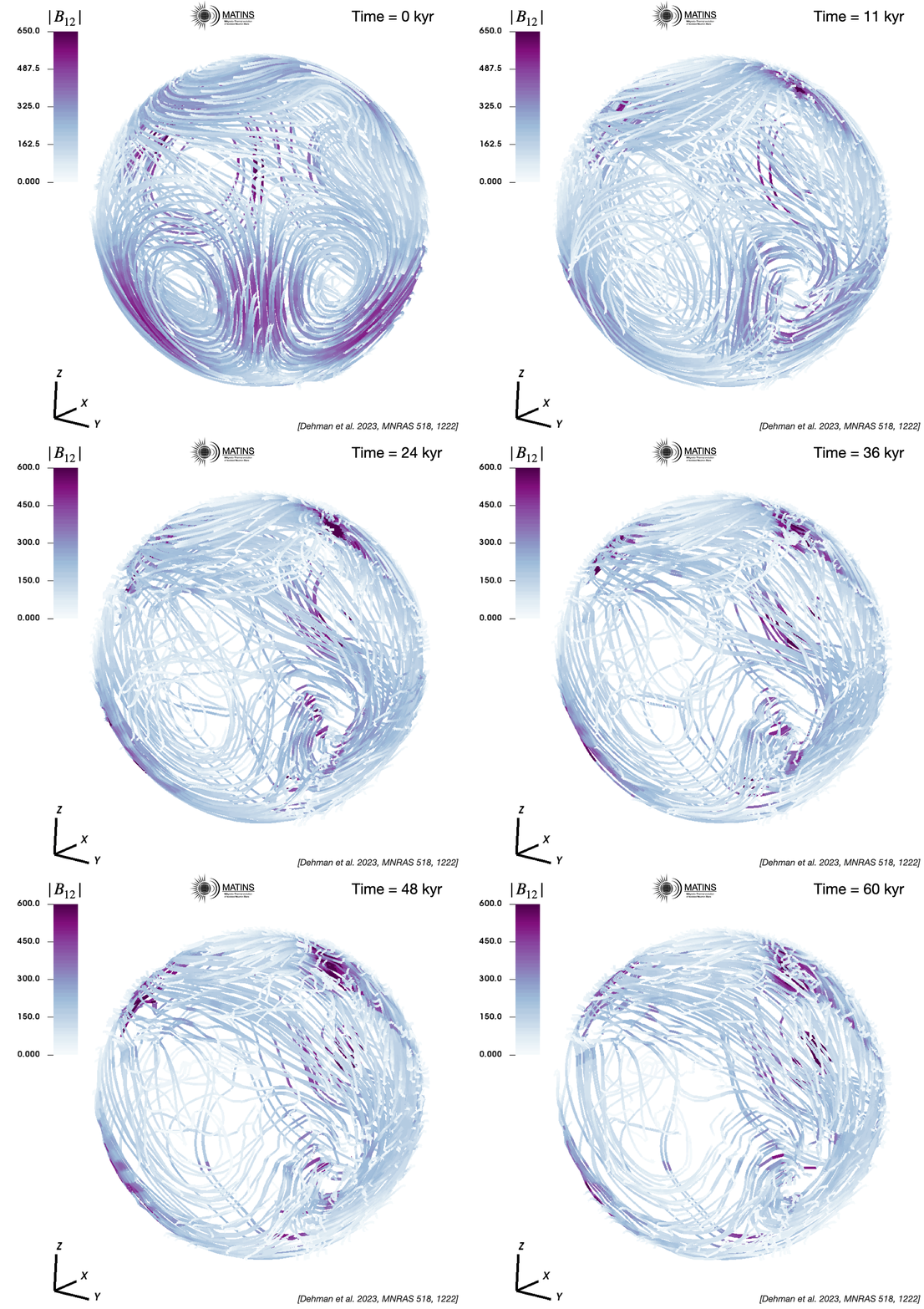
From a physical standpoint, MATINS solves the induction equation in the crust, incorporating Ohmic dissipation and Hall drift—key mechanisms driving magnetic energy cascades and surface heating in magnetars. This equation is coupled to a 3D cooling model that tracks local crustal temperature evolution, treats the core as a single thermal cell, and uses an envelope model as a boundary condition to provide the stellar surface temperature. MATINS also computes the Tolman–Oppenheimer–Volkoff structure, enabling the consistent use of various tabulated cold-matter equations of state from the CompOSE database and stellar masses throughout the crust and core. Temperature-dependent microphysical properties in both regions are obtained from the IOFFE repository, ensuring precise coupling of thermal and magnetic evolution. Computationally, MATINS employs a finite-volume scheme discretized on a cubed–sphere coordinate system, representing the stellar surface with six interconnected patches and circumventing the coordinate singularities inherent to spherical grids.
MATINS facilitates self-consistent evolution over one million years and accurately models key observables of isolated neutron stars, including X-ray thermal emission, surface magnetic fields, and rotational properties. MATINS further enables pulsar population synthesis—connecting magnetic evolution to spin and birth characteristics—and simulates magnetar bursts driven by crustal stress release, capturing flaring rates as functions of age and magnetic geometry.