
Pulsar Braking Index
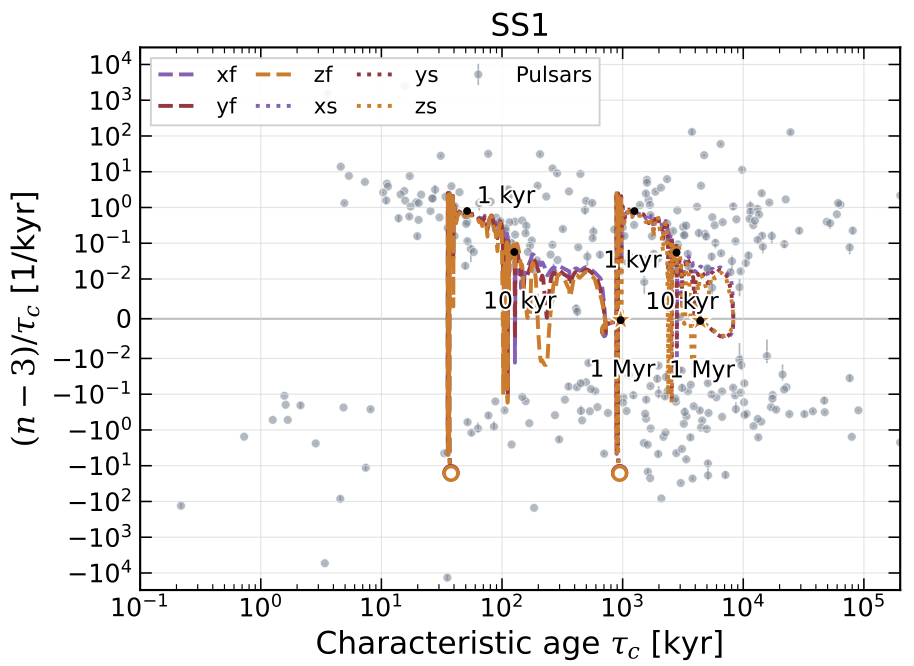
A pulsar’s braking index tells us how its spin-down changes over time: for a constant magnetic dipole it should equal 3. Measurements of hundreds of pulsars tell a different story, with values below 3 in young pulsars, above 3 at middle ages, and large values of both signs in older ones. Using long-term 3D magneto-thermal simulations, we showed that this pattern can arise naturally if neutron stars are born with tangled, small-scale magnetic fields, as supernova simulations suggest. In these stars the small scales keep feeding the large-scale dipole, which can grow or decay, while the magnetic axis spontaneously wanders across the star on timescales as short as a few thousand years. These changes can produce the large, sign-alternating braking indices observed in older pulsars, something the usual dipole-dominated models cannot do.
Related publications
C. Dehman, D. Viganò, Spontaneous wandering of the magnetic axis in pulsars: 3D magneto-thermal simulations and the imprint on braking indices, Submitted for publication, 2026. PDF | arXiv